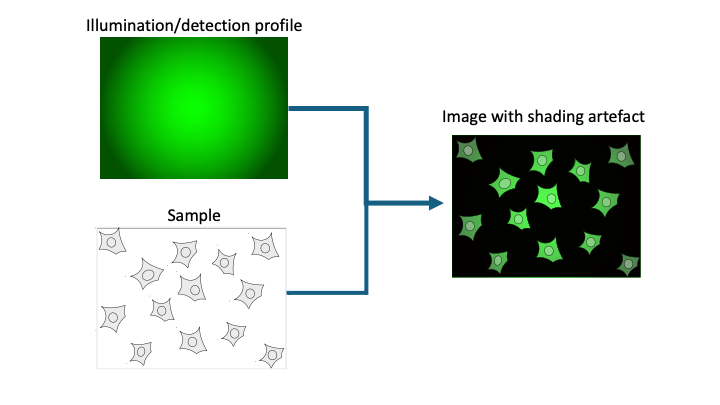
Non-uniform illumination and shading artefacts are common image quality issues where brightness varies unevenly across an image, often appearing as vignetting (darker corners), streaks, or gradient shadows. These effects arise from lighting inefficiencies, detection limitations, and/or light path obstructions. They degrade the image quality and confuse intensity-based analysis and image processing.
Prerequisites
Before starting this lesson, you should be familiar with:
The images show cells stained for their nuclei (Hoechst, 1st channel) and actin (phalloidin, 2nd channel) Do you notice a pattern of intensity difference from the center to the corner?
How does this affect your intensity measurements?
Open an image obtained from the same setup but with an homogeneous fluorescent slide xy_16bit__homogeneous_slide.tif. The intensity pattern is typical for widefield and gaussian illumination.
Discuss the pattern and how it matches what is observed with the biological sample
ImageJ macro
// Close all imagesrun("Close All")// Open the first image open("https://github.com/NEUBIAS/training-resources/raw/master/image_data/shading_tiling/xyc_16bit__hoechst_phalloidin_tile_01.tif")makeLine(50,50,2250,2250);run("Plot Profile");// Open the first image open("https://github.com/NEUBIAS/training-resources/raw/master/image_data/shading_tiling/xyc_16bit__hoechst_phalloidin_tile_02.tif")makeLine(50,50,2250,2250);run("Plot Profile");// Open the slide imageopen("https://github.com/NEUBIAS/training-resources/raw/master/image_data/shading_tiling/xy_16bit__homogeneous_slide.tif")makeLine(50,50,2250,2250);run("Plot Profile");