Smart microscopy - adjustment of the acquisition parameters
This module explains the workflow for automatically improving image quality using feedback microscopy.
Insufficient image quality often caused by sub-optimal image analysis settings. In case of multiposition imaging of heterogeneous samples, it is hardly possible to set up optimal imaging parameters for each field of view. In case of cyclic or time-lapse imaging, optimal imaging settings might change over time due to the changes in the imaged samples.
Smart microscopy can make use of automated image analysis for scoring image quality (e.g. brightness, SNR, sharpness) and improving this score via adaptive control of critical image analysis parameters.
Prerequisites
Before starting this lesson, you should be familiar with:
Tool for designing Smart Microscopy workflows with the possibility for automated adjustment of light intensity, exposure time or other parameters influencing the average photon counts for the emitted light.
(Advanced/optional) automated control of objective correction collar or other parameters controlling image sharpness.
Image histogram
Signal-to-Noise ratio (SNR)
Learning Objectives
After completing this lesson, learners should be able to:
Learn how automated adjustment of imaging settings can improve image quality
Test workflows for automated improvement of SNR and image sharpness
Concept map
Figure
Activities
Optimisation of image brightness
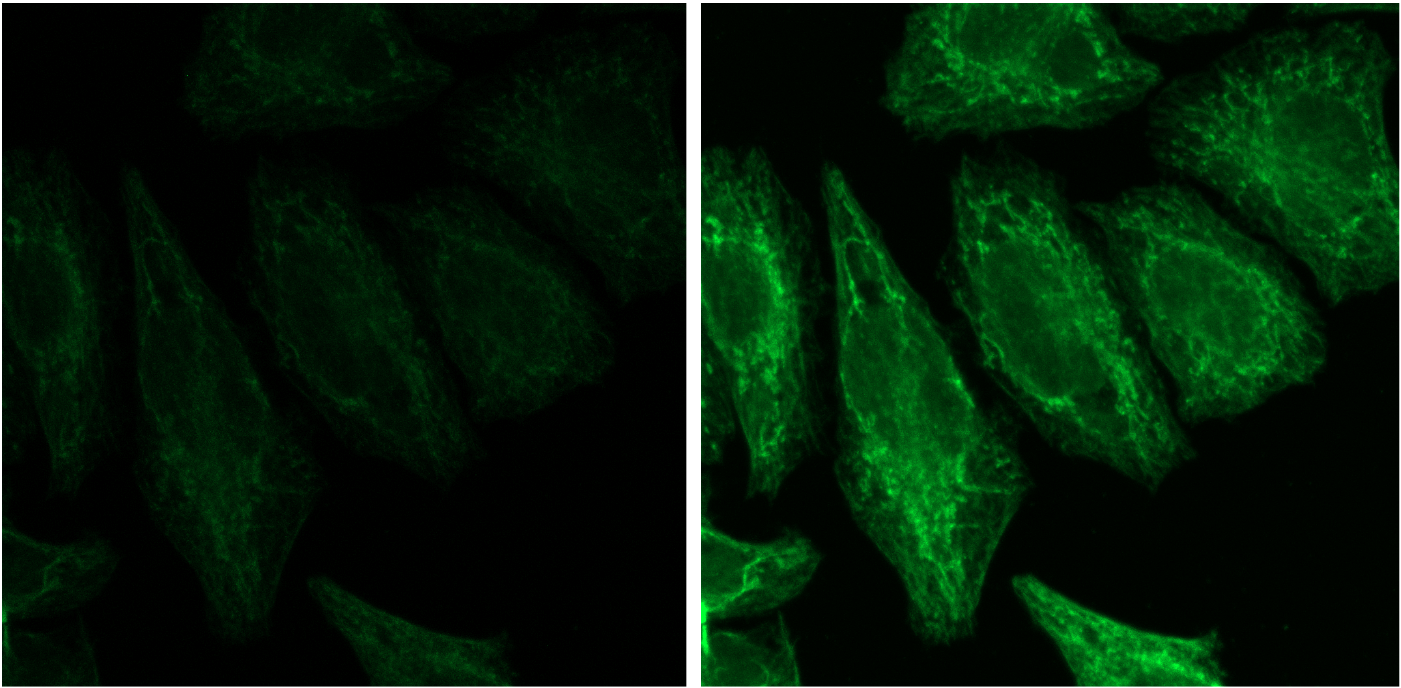
Set up the workflow for optimising image brightness and SNR using sample with fixed cells and stained microtubules
- Setup imaging settings for stained tubulin sample
- Set up an image analysis function to calculate range of image histogram
- Define target range for image histogram
- Adjust one of imaging settings (either power of excitation light or exposure time) to match the expected target range
- Set up function that calculates adjustment of imaging settings
- Construct the workflow as shown on the concept map using definitions above.
- Modify the workflow to ensure that the same image settings are used for all fields of view in the multiposition experiment. The adjustment acquisition parameters should be calculated only for the first field-of-view, new analysis settings should be then used for all other fields-of-view
Show activity for:
Zeiss ZEN Experiment Feedback
Introduction
Pre-requisites
- Zeiss Imaging instrument (e.g. AxioObserver, LSM)
- ZEN as the imaging control software
- Smart Acquisition Toolkit
Detailed guidelines
Assessment
Questions
- Which parameters need to be automatically controlled for improving image SNR?
- Why optimal imaging settings can change for cyclic staining and time-lapse experiments?
Answers
- Laser power, exposure time, scanning speed, averaging, objective correction collar
- In cyclic staining-restaining experiments labelling efficiency might differ significantly between cycles due to differences in the labelling efficiency or biological reasons. In time-lapse experiments, morphology and signal strengh in the live specimen often change over time due to change of the sample itself or fluorescence bleaching.
Follow-up material
Recommended follow-up modules:
Learn more: